


Barcelona's old town is a maze of medieval lanes, but the city most visitors picture was built a little later, on the broad grid of the Eixample. Around 1900, wealthy families competed to hire the boldest architects of Catalan Modernisme, and the result is a district where apartment blocks look like dragons, quarries and castles.
This short walk follows four of those buildings, all of them famous, from Passeig de Gràcia to the Sagrada Família. You can admire every stop from the street, and pick one interior if you want to go inside.
Casa Batlló: the house of bones
Start at Casa Batlló, an ordinary house that Antoni Gaudí remodelled between 1904 and 1906. Locals call it the Casa dels ossos, the house of bones, for its skeletal balconies and pillars. Look up at the roof: its arched, scaled ridge is often read as the back of a dragon, with the turret and cross as the lance of Saint George. Next door at number 41 stands Casa Amatller, one of the rival Modernista houses that give this stretch the nickname the Block of Discord.
La Pedrera: the stone quarry
A few blocks up the avenue, La Pedrera (Casa Milà) was Gaudí's last private house, built between 1906 and 1912 for Pere Milà and Roser Segimon. Its rippling stone front looked so rough to disapproving neighbours that they nicknamed it "the stone quarry", and the name stuck. On the roof, chimneys shaped like helmeted sentinels led the poet Pere Gimferrer to call it "the garden of warriors".
Casa de les Punxes: a castle for three sisters
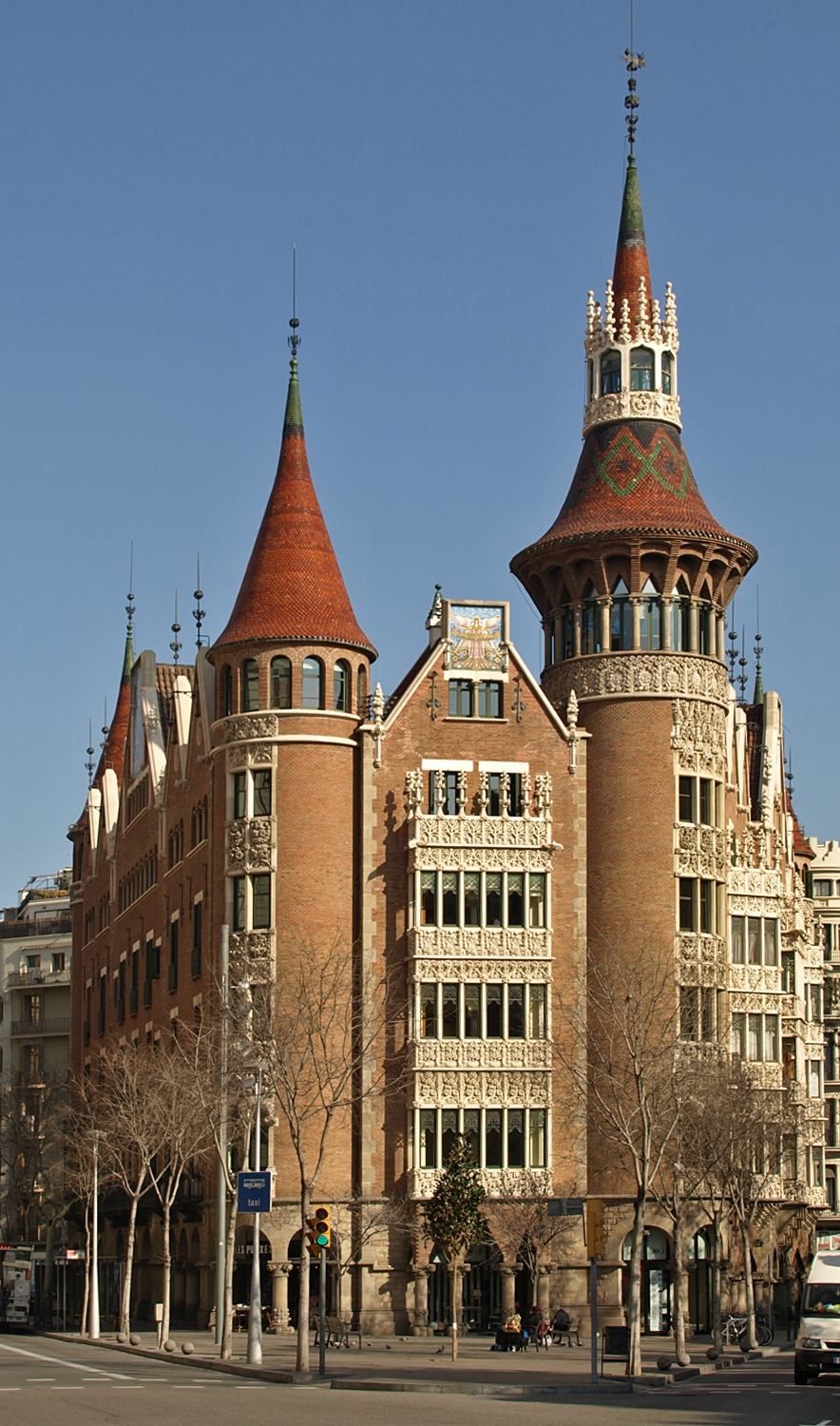
Gaudí was not the only star. Josep Puig i Cadafalch began Casa de les Punxes, also called Casa Terradas, in 1905 for the three Terradas sisters, each of whom had her own house inside the block. Its six spiked towers give it the look of a northern European castle dropped into the grid. On the Carrer del Rosselló side, a ceramic panel shows Saint George slaying the dragon, with a plea to the patron saint to give Catalonia back its freedom.
The Sagrada Família: a church still rising
End at the Sagrada Família. Work began in 1882, and Gaudí took over a year later, devoting the rest of his life to it. He died in 1926 and is buried in its crypt. Pope Benedict XVI consecrated it as a basilica in 2010, yet it is still under construction. Compare the Nativity façade on the east side with the Passion façade on the west: two very different visions of the same story.
Casa Batlló, La Pedrera's roof and the Sagrada Família all charge for entry. On a two-hour walk, choose one interior and enjoy the others from the street.
In four stops you have seen how a handful of architects and patrons turned a new street grid into an open-air gallery. The fantasy, the national pride and the craftsmanship you saw along the way all meet at the Sagrada Família, which is still being finished today.