
Edinburgh has two halves. The Old Town climbed up a ridge and stayed crowded; in the 1760s the city laid out a ruled grid of streets on the open ground to the north and called it the New Town. This walk crosses that grid from west to east, from the gardens below Princes Street to a hill covered in monuments, and it climbs only at the very end.
It is a walk of things built to be looked at: a gallery on the Mound, a Gothic spire for a novelist, a column in a square, a portrait gallery with a painted frieze, a cathedral hidden among shops, and an unfinished temple on a hill. Allow half a day, and more if you go into the galleries.
The National: a gallery on the Mound
Start at the foot of the Mound, just off Princes Street, where the National sits low in the gardens. William Henry Playfair designed the building and it opened to the public in 1859. The front is classical, with columns, and it looks like a temple that has been set down between the Old Town and the new one.
The permanent collection is free to enter. If you have only a short time, pick one room rather than the whole building, then come back out into the gardens.
The Scott Monument: a spire for a novelist
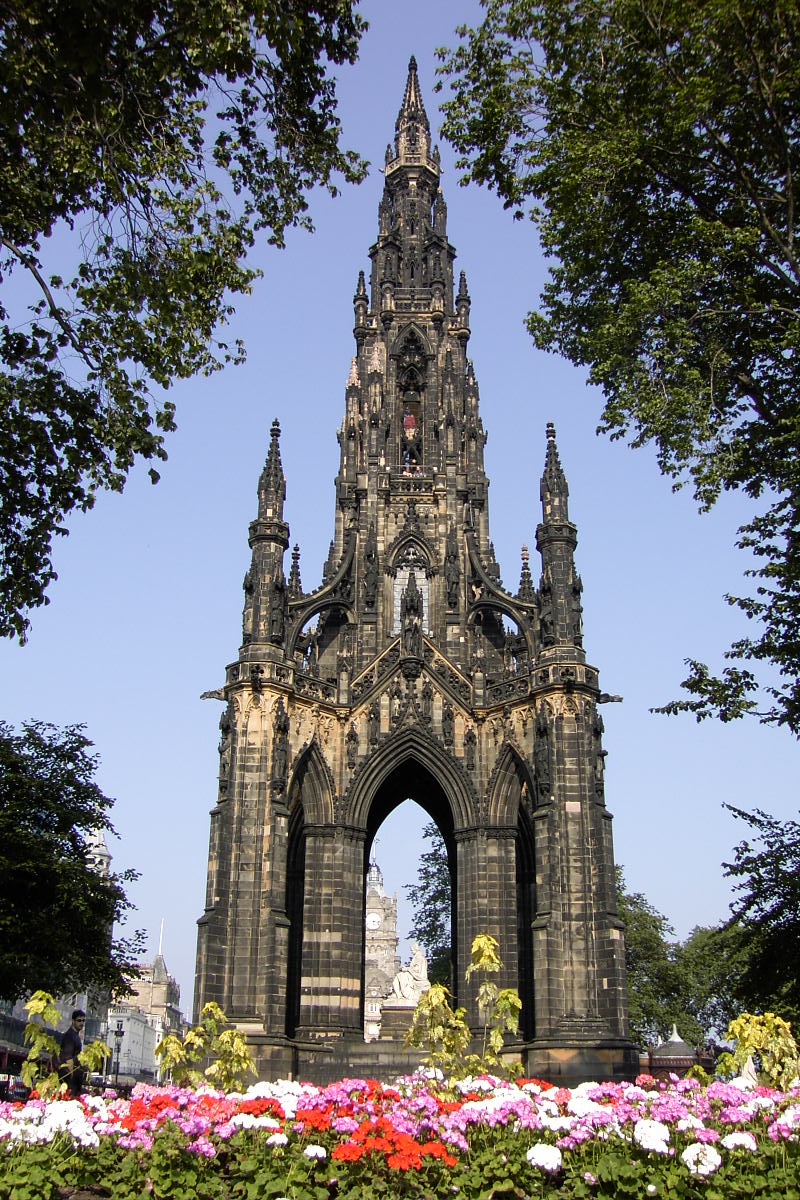
Follow the path east along Princes Street Gardens and the spire comes into view long before you reach it. The Scott Monument is a Gothic tower 61 metres high, built for Sir Walter Scott. George Meikle Kemp, a self-taught architect, won the design competition, and the monument was inaugurated in 1846.
Stand at the foot and look up. There are 68 statues on the tower, most of them characters from Scott's novels, such as Rob Roy, Ivanhoe and Jeanie Deans. Under the arch sits John Steell's marble Scott, with his dog Maida at his side. A stair of 287 steps leads to the top platform, if you want the view over the roofs.
St Andrew Square Garden: the New Town's first square
Leave the gardens by the steps at the east end and cross Princes Street, heading north. Within a couple of minutes you are in St Andrew Square Garden, the start of the New Town proper. Construction of the square began in 1772 to a plan by James Craig, the architect whose design won the competition for the whole New Town.
The garden itself has been open to the public only since 2008. A fluted column in it commemorates Henry Dundas, first Viscount Melville. Look at the buildings round the square too: Dundas House, designed by Sir William Chambers and built between 1772 and 1774, has been a bank headquarters since 1825.

Portrait: faces of Scotland, in a red Gothic building
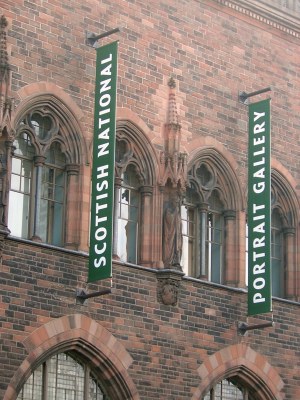
Walk north along the straight street out of the top of the square and turn along Queen Street. The Scottish National Portrait Gallery, now called Portrait, is the red building at the end. Robert Rowand Anderson designed it in Gothic Revival style, and it was built between 1885 and 1890.
The reason to go in is the entrance hall. William Hole painted the long procession frieze there in 1898, showing figures from Scottish history. The collection holds about 3,000 paintings and sculptures, including Raeburn, Ramsay and Nasmyth's portrait of Robert Burns. Entry is free.
St Mary's Metropolitan Cathedral: a church among the shops
Head east and the streets turn busier. At the top of Leith Street, on Broughton Street, you will find St Mary's Metropolitan Cathedral, the Catholic cathedral of Edinburgh. It began as a chapel designed by James Gillespie Graham in 1813-14, which opened in 1814 and replaced an earlier chapel on Blackfriars Wynd.
It has been altered many times since: aisles were added after a fire at the neighbouring Theatre Royal in 1892, and the roof was raised in 1932. Inside is the National Shrine of Saint Andrew. The cathedral is an active place of worship, so keep quiet and check the doors are open before you plan to go in.

Calton Hill: the monuments and the view
Cross the main road and take the steps up the hill, the last climb of the walk. Calton Hill has no gate and no ticket, and from its top you see the castle, Arthur's Seat and the Firth of Forth in one sweep.
The hill is covered in monuments. The National Monument was meant to be a replica of the Parthenon, a memorial to Scottish soldiers and sailors killed in the Napoleonic Wars. Building started in 1826 and stopped in 1829, when the money ran out, and only the columns were finished. It earned the nickname Edinburgh's Disgrace. Robert Burn designed the Nelson Monument nearby in the shape of an upturned telescope, and it may be closed to visitors, so admire it from outside and check before you plan to go up. The Dugald Stewart Monument is on the hill as well. From the Old Observatory tower, Robert Barker made his panorama of Edinburgh in 1787, described as the first panorama in the world.
The hill is also where the Beltane Fire Festival is held every year on 30 April.

Coming down
The walk runs from a classical gallery to a classical ruin, and the New Town grid between them was built to match. The monuments have one thing in common: Edinburgh built them to be seen from a distance. Take in the view while the light lasts, then walk back down to Princes Street before the paths get dark.