
Downtown Lisbon is the city rebuilt after 1755. A few kilometres west, on the bank of the Tagus, Belém is the city that came before: the riverside where ships left for Africa, India and Brazil, and where Portugal's kings spent the money those voyages brought home.
This half-day walk follows Belém from east to west along the river. It starts with the royal coaches and the palace where the president now lives, spends time at Jerónimos Monastery, crosses a garden laid out for a 1940 exhibition and ends at two stone figures of the Age of Discovery: a 20th-century monument and a 16th-century tower.
National Coach Museum
Begin with the strangest collection in Lisbon. The National Coach Museum opened in 1905 at the initiative of Queen Amélia, wife of King Carlos I, in the old Royal Riding School of Belém Palace. Since 2015 most of the collection has stood across the road in a long, raised building designed by the Brazilian architect Paulo Mendes da Rocha.
Inside are coaches, carriages, sedan chairs and litters from the 16th to the 19th centuries, most of them from the Portuguese royal house. The oldest vehicle in the collection is the coach of Philip II. The showpieces are the gilded coaches of an embassy that entered Rome in 1716, carved with figures of the oceans: a reminder of how far the money from the sea reached.

Belém National Palace
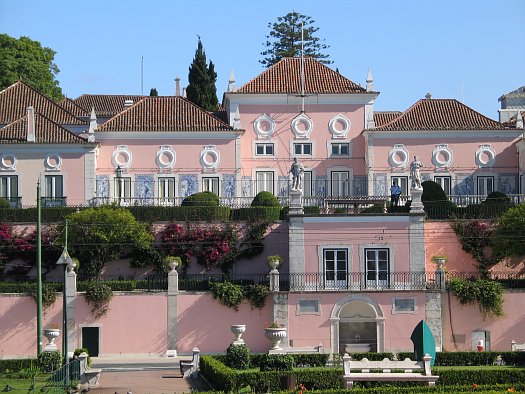
Across the road, Belém National Palace faces Afonso de Albuquerque Square. It was a royal residence until the monarchy fell in 1910 and passed to the state; today it is the official residence of the President of Portugal.
The old riding school where the coach museum began is part of the same complex. Since 2004 the Museum of the Presidency has told the story of Portugal's presidents here, but for most first-time visitors the palace is a façade to stop in front of before walking west along Rua de Belém.
Jerónimos Monastery
This is the stop to give the most time. King Manuel I ordered Jerónimos Monastery built as a resting place for his dynasty, and work began in 1501; it took about a century to finish. It was paid for largely with a tax on the trade from Africa and the East, so the voyages literally built it.
Diogo de Boitaca drew the first plans and João de Castilho carried them on. Together they made it the great example of the Manueline style, Portugal's own late Gothic: look for stone ropes, knots and sea creatures twisting around doorways and columns. In the church lie Manuel I, the navigator Vasco da Gama and the poet Luís de Camões, whose epic tells da Gama's voyage; the two men's tombs were moved here in 1880. In 1983 the monastery and the Tower of Belém were listed together as a UNESCO World Heritage Site.
Império Square
Cross the road in front of the monastery into the gardens of Império Square. They were laid out for the Portuguese World Exhibition of 1940, the Estado Novo regime's great display of national history, which reshaped this whole stretch of Belém.
The paths all meet at the fountain in the middle. Turn around there for the best view of the monastery's long façade, then carry on towards the river.

Monument to the Discoveries
On the riverbank rises the Monument to the Discoveries, a 56-metre stone prow pointing out over the Tagus. A first version in temporary materials was made for the same 1940 exhibition by the architect Cottinelli Telmo and the sculptor Leopoldo de Almeida; the permanent monument was inaugurated in 1960, for the 500th anniversary of the death of Henry the Navigator.
Henry leads the procession at the front, holding a caravel, with 33 figures from the Age of Discovery lined up behind him on the two ramps. In front of it, a compass rose 50 metres across, a gift from South Africa, holds a world map in coloured stone tracing Portugal's routes.

Tower of Belém
Follow the riverside path west to the end of the walk. The Tower of Belém was built between about 1514 and 1519 by the military architect Francisco de Arruda, to guard the entrance to Lisbon from the river. It became the city's ceremonial gateway too: the last thing the ships passed going out, and the first coming home.
It is Manueline like the monastery, with stone ropes, armillary spheres and Moorish-looking domed turrets. Look at the bases of the turrets for a carved rhinoceros, thought to be the animal Manuel I sent to Pope Leo X in 1515, the one Albrecht Dürer made famous in his print. After a year of restoration, the tower reopened in May 2026.

In half a day you have followed one idea along the river: the coaches and the monastery paid for by the sea, the tower that watched the ships go, and the 20th-century monument and garden that told the story again for a later age. If you have already walked from Rossio to the castle, Belém is the other half of Lisbon's story, and together they make a good first two days.