


The river does the navigating on this walk. Start at a power station turned gallery, keep the Thames on your left, and finish at a fortress begun in 1066, after crossing one of the best-known bridges in the world.
There are six stops, and the way between them is mostly the riverside path, so there is little map-reading to do. Allow a half day if you go inside a few places, less if you only look from outside. Each stop below says what to look at, whether it is worth going in, and the way on.
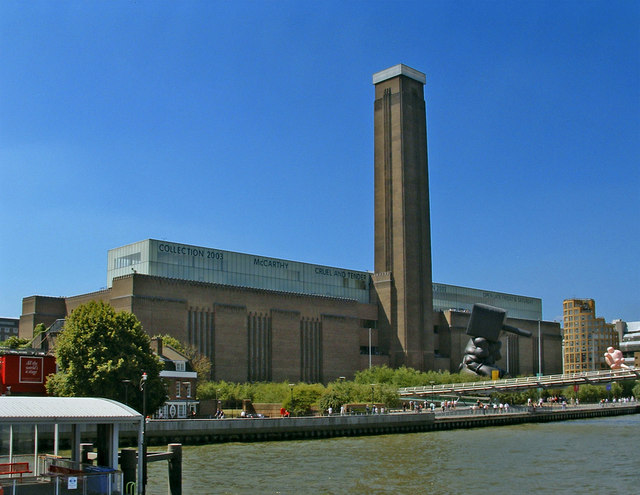
Tate Modern: a power station with a tall chimney
Tate Modern was Bankside Power Station until it shut in 1981. Giles Gilbert Scott designed it, built in two stages between 1947 and 1963, and its central chimney is 99 metres tall. Herzog & de Meuron converted it into a gallery that opened in May 2000. Look up at the chimney from the riverside before you go in.
The site of the original Globe: where Shakespeare's plays were staged
Turn inland for a few minutes to reach the site of the original Globe Theatre. The Globe went up in 1599 in Southwark, built with timber from an earlier playhouse in Shoreditch. On 29 June 1613 a stage cannon misfired during a performance of Henry VIII and set the thatch alight. It was rebuilt in 1614 and closed with all the other London theatres in 1642. Archaeologists found part of its foundations in 1989 on Park Street, and the shape of them is now marked out on the surface. The reconstructed Shakespeare's Globe, opened in 1997, stands about 230 metres away.
London Bridge and the Shard: the crossing and the tower beside it
Several bridges called London Bridge have crossed the river here since Roman times. The one you are looking at opened in 1973 and is a plain box girder of concrete and steel, so the stop is about the position rather than the design.
The Shard stands beside London Bridge station. It has 95 storeys and was designed by Renzo Piano. You can look up at it from the street without going in.
HMS Belfast: a warship moored in the river
HMS Belfast is a Royal Navy cruiser, launched in March 1938. She helped sink the German battleship Scharnhorst at the Battle of North Cape on 26 December 1943, and in June 1944 she was the headquarters ship of the bombardment force for the Normandy landings. She was towed to this berth in 1971 and has been a museum ship ever since, part of the Imperial War Museum since 1978.

Tower Bridge: the bridge people mean when they say London Bridge
Tower Bridge opened in 1894 after eight years of work. Horace Jones designed it and John Wolfe Barry engineered it. The two central leaves are raised to let tall ships pass, and the bridge sits right beside the Tower of London, so it makes the natural way to finish the walk.
Tower of London: a fortress where the walk ends
The Tower of London dates from the Norman Conquest: William the Conqueror's men founded it late in 1066, and the White Tower at its centre went up from about 1078. The Yeoman Warders who guard it have served as the royal bodyguard since at least 1509. UNESCO listed it as a World Heritage Site in 1988. Look first at how the pale keep rises above the later walls around it.
Finishing the walk
The route runs west to east along one river, and each stop is in sight of the next. Together they take in a converted power station, Shakespeare's playhouse, a Second World War cruiser, a Victorian bridge and a Norman fortress, with the Thames beside you throughout.
Collection displays at Tate Modern are free, but check Tate's website for opening times, which differ on Friday and Saturday evenings. Going inside every stop takes more than half a day, so choose one or two to enter.