

Most first visits to Munich begin at Marienplatz. This walk starts a little further out, in the quarter where Bavaria's kings set out to show the world what kind of capital they wanted. King Ludwig I dreamed of an Athens on the Isar, and his architects gave him temples for sculpture and a palace for paintings. Before him, his baroque ancestors had built a yellow, Roman-style church to give thanks for an heir.
The twentieth century left its own marks on these same squares, and the walk does not skip them. Six stops lead from Königsplatz to the edge of the English Garden. There is time to go inside at least one museum, so pick the one that tempts you most.
Königsplatz
Begin on Königsplatz, a broad square framed by three buildings that look as if they came from ancient Greece. The Glyptothek on the north side was built from 1816 to 1830 by Leo von Klenze for Ludwig I's collection of Greek and Roman sculpture, and it is Munich's oldest public museum. Inside are the marble figures from the temple of Aphaea on Aegina and the Barberini Faun, a sleeping satyr carved around 220 BC. Facing it stands the Staatliche Antikensammlungen, designed by Georg Friedrich Ziebland.
The gateway at the west end is the Propyläen, which Klenze completed in 1862. Ludwig paid for it himself, as a memorial to his son Otto becoming king of Greece. History was unkind to the gesture: in the same year a coup in Greece sent Otto fleeing back to Bavaria on a British warship.
The square also has a darker past. The Nazis held mass rallies here, burned books here in 1933, and built two Honour Temples on the east side for their dead of the 1923 putsch. The US Army blew them up in 1947, and their platforms are still there.

Alte Pinakothek
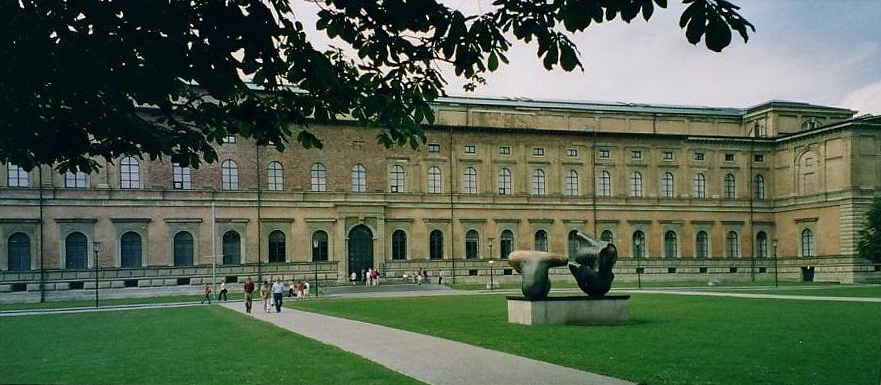
A few streets north-east, Ludwig's paintings got a palace of their own. Klenze designed the Alte Pinakothek in 1826 and it opened ten years later, in 1836. Its walls hold Dürer's Self-portrait and his Four Apostles, Leonardo's Madonna of the Carnation, Raphael's Madonna Tempi and Rubens's huge Great Last Judgement.
Look hard at the outside before you go in. In December 1944 an aerial mine tore a hole about 45 metres wide in the facade. When Hans Döllgast rebuilt it from 1952, he refused to fake the old stonework. He filled the gap with plain rubble brick, and the scar is still easy to read on the building today.
Theatinerkirche
Head south-east to Odeonsplatz, where the yellow front of the Theatinerkirche looks as if it had been lifted from Rome. In a sense it was. The ruling couple, Elector Ferdinand Maria and Henriette Adelaide of Savoy, vowed to build it when they finally had an heir, Max Emanuel, born in 1662. The architect Agostino Barelli took Sant’Andrea della Valle in Rome as his model. The dome and towers were finished by Enrico Zuccalli in 1690, while the Rococo facade, by François de Cuvilliés, came only in 1768.
Inside, the church is a cool white world of stucco, with a large black pulpit from 1686. Several generations of Wittelsbachs rest in the crypt below, among them the founding couple themselves.
Feldherrnhalle
Across the square, the open loggia of the Feldherrnhalle closes off the long view down Ludwigstraße. Ludwig I commissioned it from Friedrich von Gärtner, who built it between 1841 and 1844 on the model of the Loggia dei Lanzi in Florence. It honours the Bavarian army, with statues of the generals Tilly and Wrede, and the two lions on the steps were added in 1906.
On 9 November 1923 this was where Hitler's Beer Hall Putsch ended. Bavarian police stopped the marchers in a gunfight that left four policemen and fifteen putschists dead. Under the Nazis a memorial to their dead stood here, guarded by the SS, and passers-by were expected to salute. Many slipped round the back instead through the narrow Viscardigasse, which Munich still remembers as Drückebergergasse, shirkers' lane.

Hofgarten
Go through the Hofgarten gate on the east side of Odeonsplatz and the noise of the city drops away. The Hofgarten was laid out in 1613 to 1617 for Elector Maximilian I as an Italian Renaissance garden. Its paths lead to the Temple of Diana, an eight-arched pavilion of 1615. On its roof stands a copy of Hubert Gerhard's bronze Bavaria; the original is inside the Residenz.
The arcades along the sides are painted with scenes from Bavarian history. At the far end stands the Bavarian State Chancellery, in the former Army Museum. In the north-east corner, a black granite memorial honours the White Rose, the students executed for resisting Hitler.

Haus der Kunst
The last stop brings the story into the twentieth century. The colonnaded Haus der Kunst on Prinzregentenstraße was designed by Paul Troost and built from 1933 to 1937 as the Haus der Deutschen Kunst, a showcase for Nazi art policy. After the war the American army used it as an officers' mess, and since 1946 it has shown art again. Today it has no permanent collection and is a venue for international contemporary art, so it is worth checking what is on.
Right beside it, the Eisbach stream rushes out under the Prinzregentenbrücke and forms a standing wave at the southern edge of the English Garden. Watch the river surfers from the bridge. After the wave vanished in 2025, the city allowed surfing again in May 2026.
The Glyptothek and the Alte Pinakothek are both closed on Mondays, and the Haus der Kunst on Tuesdays. On Sundays, admission to the Alte Pinakothek is 1 euro.
In half a day you have seen royal Munich at its most ambitious: Greek temples for sculpture, a palace for paintings, an Italian church and a Florentine loggia. You have also seen how the twentieth century used and misused that stage, and how the city has lived with those marks since. From the bridge, the English Garden is right in front of you if you still have the energy.