


Most of what a first-time visitor comes to Rome to see lies along one line across the centre. The ancient city is at the eastern end, around the Colosseum. The fountains, steps and squares of the popes fill the middle, inside the bend of the Tiber. The Vatican is across the river to the west. This guide follows that line in a single day, so the walk also runs roughly forward in time: imperial Rome in the morning, Baroque Rome after lunch, Saint Peter's at the end.
It is a day of ten stops, and it works only if you are strict about where you go in. The plan is to go inside one place in the morning, the Colosseum, and one in the afternoon, the Pantheon, and to see the rest from outside, which is how most of them are meant to be seen. Rome's museums need days of their own and are left out. Wear shoes for cobbles, carry water, and start early.
1. The Colosseum: start where the queues are shortest
Begin at the Colosseum when it opens. Our records give 8:30 all year, with closing times that move with the season: 19:15 in summer, 18:30 in the first weeks of October and 16:30 through the winter.
The emperor Vespasian began the amphitheatre in the early 70s AD and his son Titus opened it in AD 80. It is the largest amphitheatre the ancient world built. Modern estimates of its capacity start at about 50,000 people. Inside, look down first: the arena floor is gone, so you see straight into the corridors and cells underneath, where animals and fighters waited before a show. Then look at the outer wall from within. Only the northern side still stands to its full height. The rest was brought down by earthquakes and taken away as building stone for the churches and palaces you will pass later in the day.
2. The Arch of Constantine: a monument made of older ones
A few steps from the Colosseum, the Arch of Constantine needs ten minutes and no ticket. The Senate dedicated it in AD 315 to mark Constantine's victory over his rival Maxentius at the Milvian Bridge three years earlier.
Walk around it and compare the carving. Much of the sculpture was taken from monuments of earlier emperors, Trajan, Hadrian and Marcus Aurelius, and the heads were recut. The narrow band of small, stocky figures that runs above the side arches was made for Constantine himself. The difference in style between the two is plain even to an untrained eye.
3. The Roman Forum: the centre of the ancient city
The Roman Forum was the main square of ancient Rome: the place of its law courts, temples, speeches and triumphal processions. What is left is a field of columns and foundations that takes some reading. Three things help. The Arch of Titus, at the end nearest the Colosseum, commemorates the capture of Jerusalem in AD 70. The plain brick hall at the far end is the Curia, where the Senate met. The eight columns standing near it belonged to the Temple of Saturn, which held the state treasury.
You have a choice here. The Colosseum ticket normally covers the Forum and the Palatine Hill above it, and walking through takes much of the remaining morning. If you would rather keep the day moving, follow Via dei Fori Imperiali along its edge instead. The road looks down into the ruins and costs nothing.
4. The Vittoriano: modern Italy on the Capitoline
The white building at the end of the road is the Monument to Vittorio Emanuele II, known as the Vittoriano. It was built between 1885 and 1935 to honour the first king of a unified Italy, and it is by far the youngest monument on this walk. The architect was Giuseppe Sacconi. Since 1921 it has held the Tomb of the Unknown Soldier, which is guarded day and night, so visitors are asked to behave as they would at a memorial: no sitting or eating on the steps.
Climbing the staircases and terraces is free, and they give a good view back over the route you have just walked. A lift to the roof terrace is charged for.
5. The Trevi Fountain: the end of an aqueduct
North of Piazza Venezia the streets narrow, and the Trevi Fountain arrives without warning, filling one side of a small square. Nicola Salvi designed it and Giuseppe Pannini completed it in 1762. It is built against the back of a palace, Palazzo Poli, and it marks the end of the Acqua Vergine, an aqueduct first brought into the city in 19 BC and still running. The central figure is Oceanus, on a shell chariot drawn by two sea horses, one calm and one restless.
Since 2 February 2026 visitors pay 2 euros to go down the steps to the edge of the basin. Seeing the fountain from the square is still free. The coins thrown into the water are collected and given to charity.
6. The Spanish Steps: a stair between two squares
The Spanish Steps climb from Piazza di Spagna to the church of Trinità dei Monti at the top. They were built between 1723 and 1725 to a design by Francesco de Sanctis, and paid for with a French bequest. The name comes from the Spanish embassy to the Holy See, which stands on the square below. At the foot is the Barcaccia, a fountain in the shape of a half-sunk boat, made in the late 1620s by Pietro Bernini, whose son Gian Lorenzo you will meet twice more today. The poet John Keats died in 1821 in the house on the right of the steps.
Walk up for the view over the rooftops. Do not sit down: sitting on the steps has been banned since 2019 and the fines are large. This is a natural point to stop for lunch or a rest, and our food guide to Rome describes the tea room beside the steps.
7. The Pantheon: the one interior of the afternoon
From the steps the route turns back south-west into the old centre. The Pantheon is the best-preserved building of ancient Rome, rebuilt under the emperor Hadrian and used as a church since AD 609. That long service as a church is why it still has its roof. Our walk through six churches of the centre tells its story in full, so here is only what to do: go in, stand under the round opening at the top of the dome, and watch the disc of light it throws on the wall.
Visitors have needed a ticket since July 2023. Our records give opening hours of 8:30 to 19:15 from Monday to Saturday and 9:00 to 17:45 on Sunday, with step-free access.
8. Piazza Navona: a racetrack turned into a square
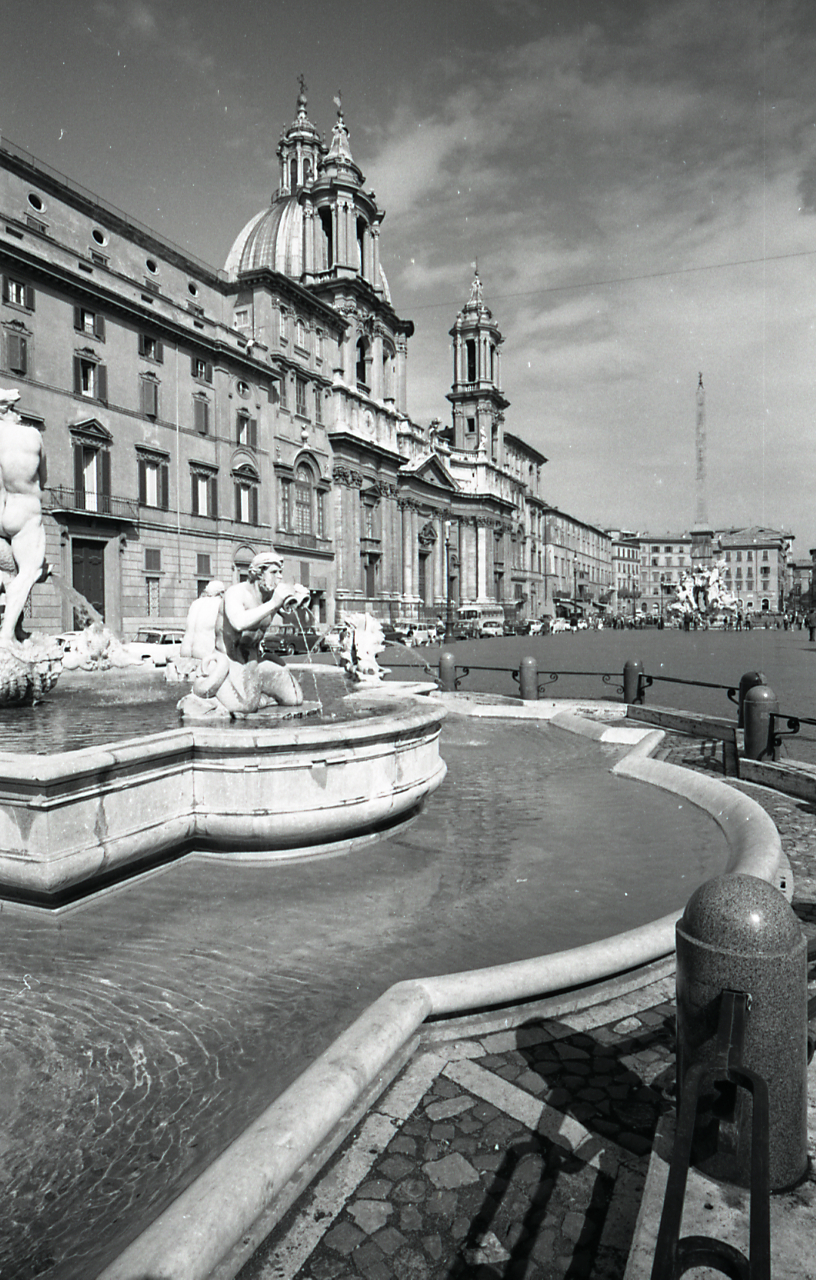
Piazza Navona is long, narrow and rounded at one end because it stands on the Stadium of Domitian, an athletics track of the first century AD. The houses were built on the foundations of the seating, and the square kept the shape of the track.
Its present look is the work of one pope, Innocent X, whose family palace faces the square. In the middle is Gian Lorenzo Bernini's Fountain of the Four Rivers, finished in 1651: four giants for the Danube, the Ganges, the Nile and the Río de la Plata, seated around a rock that carries an Egyptian-style obelisk. Behind it is the church of Sant'Agnese in Agone, with a curved front by Bernini's rival Francesco Borromini. Tables here are priced for the view, so sit only if you want the view.
9. Castel Sant'Angelo: a tomb, a fortress and a bridge
The walk now reaches the Tiber. On the far bank stands the Castle of the Holy Angel, Castel Sant'Angelo, a great drum of masonry that the emperor Hadrian commissioned as a tomb for himself and his family. The popes later turned it into a fortress and linked it to the Vatican by a raised corridor. Pope Clement VII took shelter in it when Rome was sacked in 1527. The bronze angel on top recalls a legend that the archangel Michael appeared there in 590 to mark the end of a plague.
Cross by the Ponte Sant'Angelo, the pedestrian bridge in front, which is lined with ten marble angels made to Bernini's design. The castle is a museum inside, open daily from 9:00 to 19:30 by our records. On a one-day visit the bridge and the outside are enough.
10. Saint Peter's Square: the end of the line
A straight avenue leads west from the castle to Saint Peter's Square, which lies in Vatican City, an independent state. Bernini laid out the square between 1656 and 1667. Two curved colonnades, each four columns deep, reach out from the basilica, and the saints stand in a row along the top. The obelisk in the centre came from Egypt in ancient times and was moved to this spot in 1586. Look for the round stones set in the pavement on either side of it: from each one, the four rows of columns of the nearer colonnade line up and appear as one.
If you have the energy, Saint Peter's Basilica is open until 20:00 by our records, and entry is free after a security check. Shoulders and knees must be covered. Michelangelo's Pietà is in the first chapel on the right.
Book the Colosseum for a set time before you travel, and check the current rules and hours for the Pantheon and the Trevi Fountain in the week you go: all three have changed how they admit visitors in the last few years. Rome's street fountains, the small iron ones called nasoni, run with drinking water, so a refillable bottle is all you need to carry.
What the day adds up to
Ten stops in a day is a survey, and it is meant to be. You will have crossed the city from the amphitheatre of the emperors to the square of the popes, and seen how each age built on, borrowed from or took apart the one before: an arch carved from older arches, a square on a racetrack, a tomb made into a castle. You will also know which places you want to come back to. Give those the rest of your stay, along with the museums this walk passed by.