

Vienna is a city that was built to be looked at. For centuries it was the residence of the Habsburgs, and almost everything a first-time visitor comes to see was put up to impress someone: God, a rival court, the paying public, or the generation of artists that came before.
This walk strings nine of those places together in the order the city grew. It starts in the medieval core beside the cathedral, passes through the palace where the emperors lived, steps out onto the grand boulevard that replaced the city walls, and ends in the garden of a general who became richer than most kings. Along the way the mood shifts from Gothic stone to Baroque swagger, to the gilded confidence of the nineteenth century, and then to the artists who had had enough of all of it.
It is a walk of exteriors, squares and courtyards, with a handful of doors worth opening if you have the time. Take it slowly. Half a day is enough to see everything here from the outside and to go inside one or two places, not all of them.
1. Saint Stephen's Cathedral: where the city takes its bearings
Every Viennese walk worth the name starts at Saint Stephen's Cathedral, the Stephansdom, and not only because it is in the middle. It is the mother church of the Archdiocese of Vienna and the seat of its archbishop, and for most of the city's history its south tower was the tallest thing anyone here had ever seen. Locals call the building Steffl, as if it were a relative.
Before you go in, stand back far enough to see the roof. Its glazed tiles are laid in zigzags of colour, a piece of bravado on top of an otherwise sober Gothic church. Inside, the nave is tall, dim and cool, and it changes the scale of everything you have just walked past. The cathedral is open from early morning until late evening, so it works equally well as a first stop or a place to come back to.
2. The Holy Trinity Column: a promise kept in marble
Leave the square by the Graben, the broad pedestrian street whose name means ditch: it follows the line of the moat that once protected a Roman camp. In the middle of it rises the Holy Trinity Column, which the Viennese know as the Pestsäule, the plague column.
In 1679 the plague came to Vienna. Emperor Leopold I left the city and vowed that he would raise a column of thanks if the epidemic ended. The monument that finally stood here in the 1690s is one of the most theatrical things in the city: a boiling cloud of marble angels climbing towards a gilded Trinity, with the emperor himself kneeling in prayer near the base. It is Baroque Vienna in a single object, grief, gratitude and self-promotion all at once.

3. The Spanish Riding School: horses in a ballroom
From the far end of the Graben, the Kohlmarkt leads to Michaelerplatz, where the curved front of the Hofburg, the imperial palace, closes off the street like a stage set. Just beside it is the Spanish Riding School, an institution that trains white Lipizzaner stallions in a classical style of horsemanship that most of Europe gave up long ago. The name remembers the Spanish horses the breed descends from.
The riding hall itself was built in the eighteenth century and looks more like a ballroom than a stable, all white galleries and chandeliers. You will not see that from the street, and performances and training sessions need a ticket, so check what is on before you count on it. What you can often do for nothing is glance into the stable courtyard as you pass, and find a horse looking back.

4. The Schweizertor: the old castle inside the palace
Walk through the archway under the dome and you are inside the Hofburg, the former principal residence of the Habsburg dynasty. It began as a thirteenth-century castle and was extended so many times that it is less a building than a small district of wings and courtyards.
The Schweizertor, the Swiss Gate, is the door to the oldest part of it. Painted red and black, with gilded lettering that lists the titles of Ferdinand I and the date 1552, it is one of the few pieces of Renaissance Vienna to survive the later rebuilding. Its name comes from the Swiss guards who once kept watch here. Step through and the courtyard beyond is noticeably smaller and plainer than everything around it: this is what the palace was before it became an empire's headquarters.
5. Heldenplatz: the square that was never finished
A few more archways and the palace suddenly lets go of you. Heldenplatz, Heroes' Square, is a wide open space with the long curve of the Neue Burg, the last wing of the Hofburg, along one side. It was meant to be one half of a vast imperial forum; the monarchy ended before the other half was built, which is why the square feels so open on one side.
Two bronze riders give it its name. One is Archduke Charles, who fought Napoleon. The other is Prince Eugene of Savoy, the general who led the Habsburg armies against the Ottomans. Remember him: this walk ends at his house.
Heldenplatz also carries a darker memory. It was from the balcony of the Neue Burg, in March 1938, that Hitler announced Austria's annexation to a crowd filling this square. Vienna does not hide that, and a visitor should know it.

6. The Vienna State Opera: the first house on the Ring
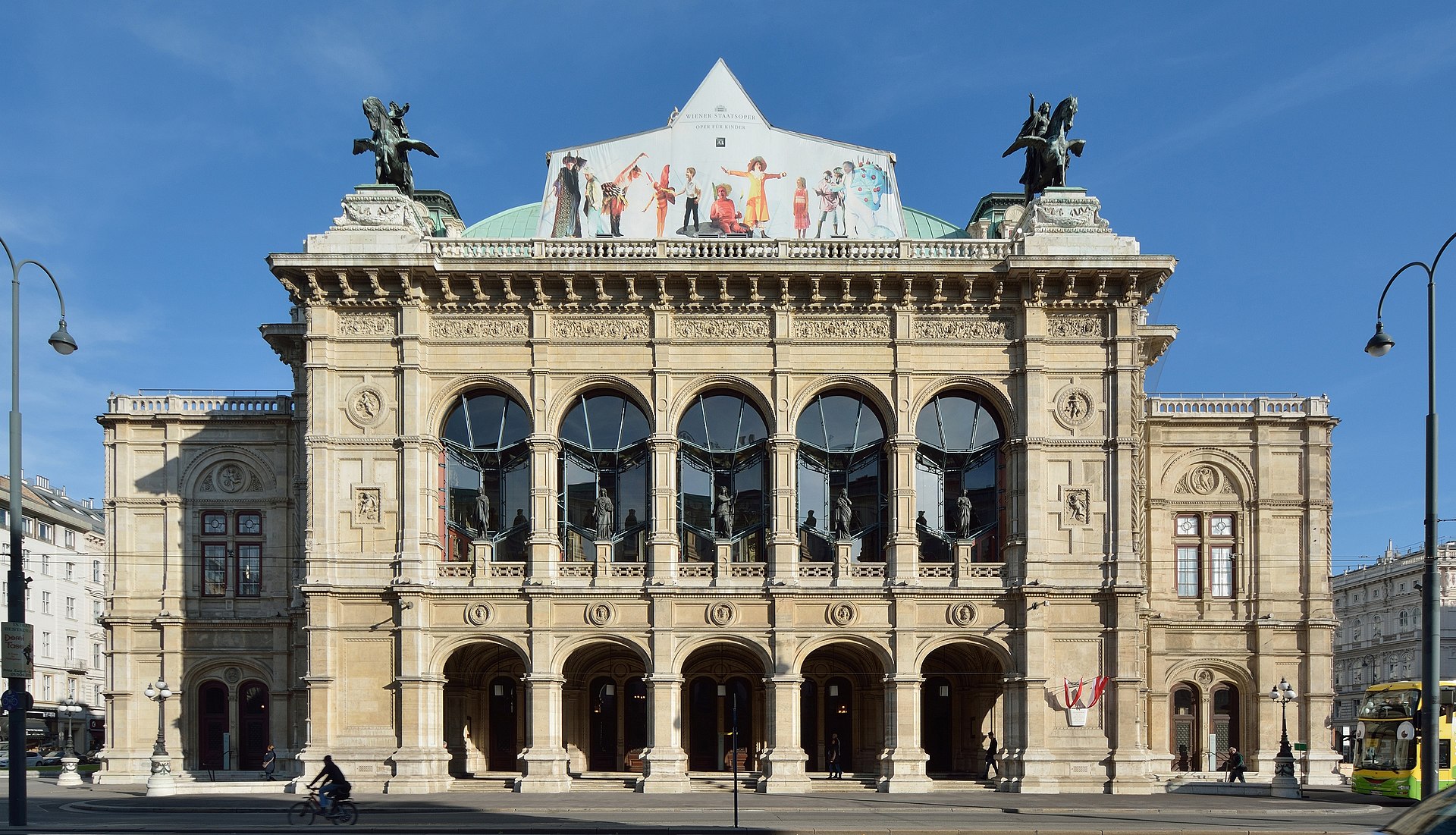
From the palace, head for the Ringstrasse, the boulevard laid out in the nineteenth century where the city walls used to stand. The Vienna State Opera was the first major building to go up along it, a Renaissance Revival house that seats 1,709 people.
Its beginnings were unhappy. The Viennese mocked the design while it was being built, and neither of its two architects lived to see it open in 1869. The city has more than made up for it since. The house was badly damaged by bombing in 1945, and its reopening ten years later was treated as a national event. Today the opera is one of the things Vienna is most sure of about itself. Look at the arcaded front facing the Ring, which survived the war, and at the people on the steps in the early evening, dressed for a performance.
7. The Secession: the golden cabbage
Now for the rebellion. In 1897 a group of artists led by Gustav Klimt walked out of Vienna's official art establishment and built themselves an exhibition hall. The Secession is the result: a low white block with almost no windows, crowned by an openwork globe of gilded laurel leaves that the Viennese promptly named the golden cabbage.
Above the door runs the group's motto, in gold: Der Zeit ihre Kunst. Der Kunst ihre Freiheit. To every age its art, to art its freedom. After the columns and statues of the Ring, the building still looks startlingly modern. It remains an exhibition space for contemporary art, and Klimt's Beethoven Frieze is kept in the basement.

According to our data the Secession is open Tuesday to Sunday, 10:00–18:00, so on a Monday you will only see it from outside. Saint Stephen's Cathedral is open every day, from 06:00 (07:00 on Sundays) until 22:00.
8. The Musikverein: the sound of New Year's morning
Cross Karlsplatz, with the great green dome and twin columns of the Baroque Karlskirche standing off to one side, and you reach the Musikverein. From outside it is a dignified terracotta-coloured building in the style of a Greek temple, opened in 1870. Inside is the Golden Hall, the home of the Vienna Philharmonic and one of the most admired concert rooms in the world.
If you have ever seen the New Year's Concert on television, with its waltzes and the audience clapping along to the Radetzky March, you have seen this room. Like the opera, it is a place to admire from the pavement unless you have a ticket. Together the two buildings explain why Vienna's reputation for music is a matter of bricks as much as of composers.

9. The Belvedere: the general's garden
The last stretch of the walk leaves the old city behind for the Belvedere, and here Prince Eugene, the bronze rider from Heldenplatz, comes back into the story. The victories that put him on that pedestal also made him very rich, and he spent the money on a summer residence on what was then the edge of town.
The complex is two Baroque palaces, the Lower and the Upper Belvedere, joined by a formal garden that rises between them in terraces, with an orangery and the palace stables alongside. The name means beautiful view, and the view is the point: from the upper terrace you look back down the garden and across the roofs to the spire of the cathedral where you started.
The Upper Belvedere is now an art museum, and its best-known painting is Klimt's The Kiss. That is a visit in itself. For this walk, the garden is the right place to stop.
What the walk adds up to
Seen in this order, Vienna's highlights are less a list than an argument carried on over six centuries. The cathedral says the city belongs to God. The plague column and the Hofburg say it belongs to the emperor. The opera and the Musikverein say it belongs to the citizens who could afford a ticket, and the Secession says, in gold letters, that it belongs to whoever is making something new.
Prince Eugene's garden is a good place to end because it lets you see all of it at once, spire and domes and rooftops, from a bench that costs nothing. Whatever you come back for tomorrow, a museum, a concert, an hour inside the palace, you will know where it sits in the story.