

For more than six centuries Vienna was governed from one palace, and for most of that time it was a walled city. Then, within a single lifetime, the walls came down, a boulevard of public buildings rose in their place, and the dynasty that had ordered it all lost its throne. This walk follows that change on the ground.
It begins on the Ringstrasse, turns inward to the places where the Habsburgs were buried and where they lived, and comes back out to the buildings in which citizens, rather than emperors, came to make the decisions. The six stops are not in strict order of date. They are in the order that lets the argument build: first the dynasty, then what replaced it.
1. Vienna State Opera: the first building on the Ring
In 1857 Emperor Franz Joseph I issued the decree known by its opening words, Es ist Mein Wille ("It is my will"), ordering Vienna's medieval walls and moats to be torn down. The open ground in front of them, the glacis, had been kept clear for military reasons. It now became building land for a new boulevard.
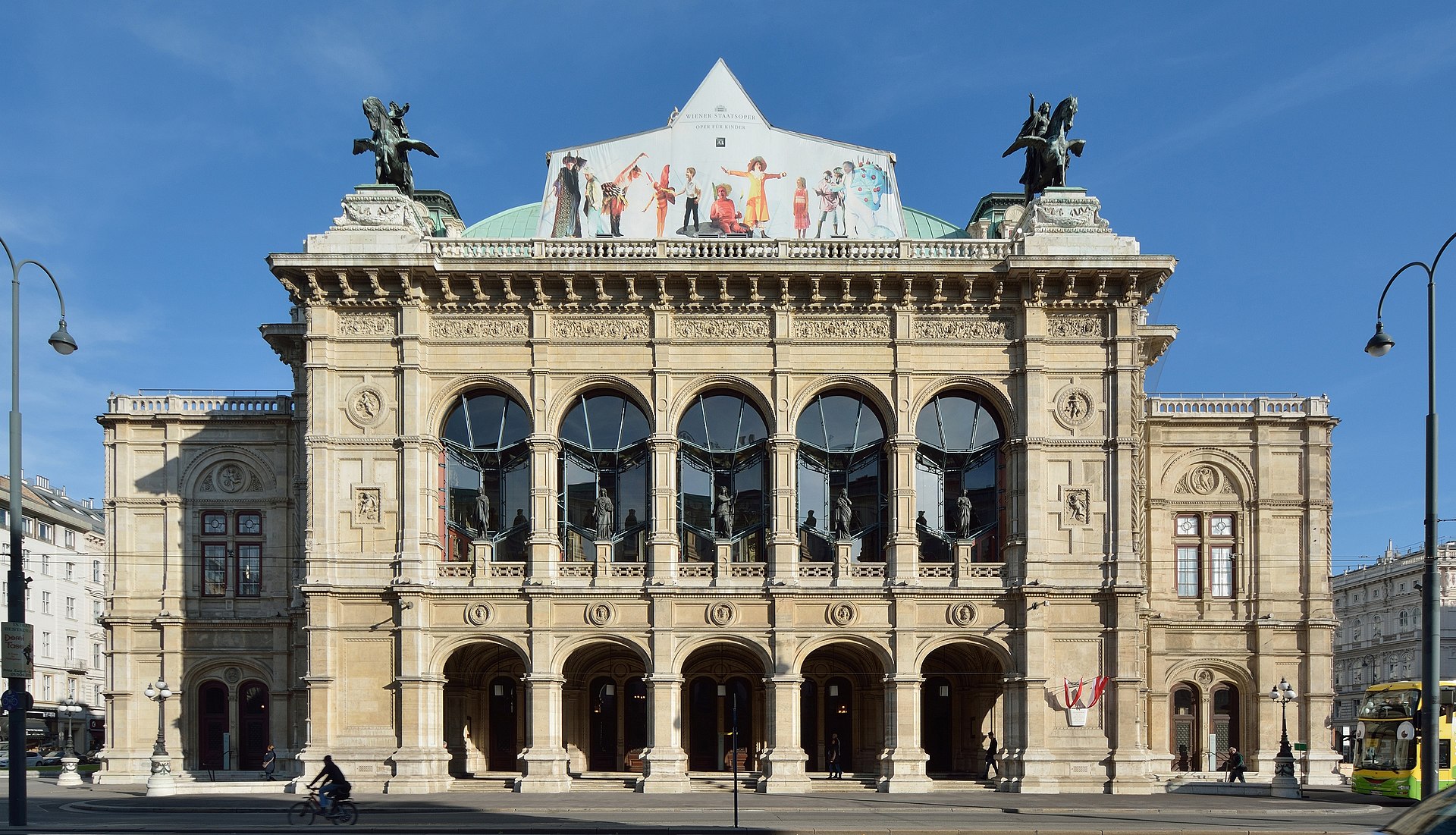
The Vienna State Opera was the first big building to go up on it. The architects Sicardsburg and van der Nüll broke ground in 1861, and the first night, on 25 May 1869, was Mozart’s Don Giovanni. Not all of it is original: an American air raid on 12 March 1945 set the house on fire. It reopened on 5 November 1955 with Beethoven’s Fidelio, in the year Austria regained its sovereignty.
2. Imperial Crypt: the dynasty underground
A short way into the old town, beneath the plain Capuchin Church on Neuer Markt, lies the Imperial Crypt. Empress Anna of Tyrol provided for a Capuchin cloister and burial vault in her will of 1617; the crypt was founded in 1618 and dedicated in 1632. It has been the Habsburgs' principal burial place ever since, and holds the remains of 145 members of the family, among them 12 emperors and 18 empresses.
The tombs show how the dynasty wished to be seen in each period. The largest is the double sarcophagus of Maria Theresa and her husband Francis I Stephen, sculpted by Balthasar Ferdinand Moll. Franz Joseph I, who ordered the Ringstrasse, is buried here too. The vault is still in use: the most recent entombment took place in 2023.
3. Schweizertor: the old gate of the Hofburg
The Hofburg was the Habsburgs' main residence, and its oldest parts date from the 13th century. Who began it is not settled: the first castle is attributed either to the last Babenberg dukes or to Ottokar II of Bohemia, who held Vienna before the Habsburgs took it. That castle was square, with four corner towers, a moat and a drawbridge.
The Schweizertor, the Swiss Gate, was its original main gate. Its present Renaissance form dates from the reign of Ferdinand I, whose many titles are set out in the inscription above the arch. The courtyard behind it, the Swiss Court, is the core from which the palace grew wing by wing for six hundred years.
4. Heldenplatz: an unfinished forum
Step out of the palace courtyards onto Heldenplatz, Heroes' Square, named for the two equestrian statues at its centre: Prince Eugene of Savoy and Archduke Charles. Under Franz Joseph the square was meant to become one half of an imperial forum reaching across the Ring to the two court museums. Only one of its curved wings, the Neue Burg, was built, and it was finished in 1913, five years before the monarchy ended. The forum remains a fragment.
The square is remembered for a later date as well. On 15 March 1938 Adolf Hitler stood on the balcony of the Neue Burg and proclaimed the annexation of Austria to a crowd filling the square below. How Austria should remember that day, and that crowd, has been argued over ever since.

5. Austrian Parliament Building: a Greek temple for a new idea
Across the Ring, the Austrian Parliament Building was built between 1874 and 1883 to designs by Theophil Hansen. He chose the Greek Revival style on purpose, giving the empire's elected assembly the architecture of ancient Athens. The Pallas Athena fountain in front, by Carl Kundmann, was completed in 1902.
The building outlived the state it was built for. On 12 November 1918, with the war lost and the emperor withdrawn from government, the Republic of German-Austria was proclaimed from the ramp in front of it. Half of the building was heavily damaged in 1945, and after five years of renovation it reopened in 2023.

6. Vienna City Hall: the citizens' tower
The walk ends at Vienna City Hall, designed by Friedrich von Schmidt and built between 1872 and 1883 in the Gothic Revival style. Its site, secured in 1870 on the persistence of Mayor Cajetan Felder, had been a parade ground on the glacis. The choice of style matters as much as the place: Gothic recalled the self-governing merchant cities of the Middle Ages.
On top of the main tower stands the Rathausmann, an armoured standard-bearer that has become a symbol of the city. The building still houses the mayor and Vienna's city and state government.
What the walk adds up to
Taken together, the six places tell one story. A dynasty rules from a moated castle and buries its dead under a monastery. It pulls down the walls and builds a boulevard to display its confidence, but the grandest buildings on that boulevard are a parliament and a city hall. The forum meant to crown the palace is never finished, the republic is proclaimed on the parliament's ramp, and twenty years later the empty half of the forum serves a dictatorship. Vienna's centre is compact enough for all of this to lie within one short walk.