
Zurich's old town is small, and its story is told by four churches within sight of each other. Two stand on the east bank, two on the west, and the Limmat runs between them. This route follows the river and climbs once, at the end.
The twin towers
Start at the Grossmünster, whose two towers are the shape you will see from every bridge in town. Building began around 1100, and the church was inaugurated around 1220. In 1520 Huldrych Zwingli began the Swiss-German Reformation from its pulpit, and four years later the organ and the statues were taken out. Stand at the foot of the towers and look up: their neo-Gothic tops date from 1787, after a fire in 1763 destroyed the wooden spires.
The church on the water
Down at the river, the Wasserkirche stands on a small island in the Limmat, which is how it got its name. A medieval tradition places the execution of the city's martyrs Felix and Regula on this spot. After the Reformation it stopped being a church, and in 1634 it became Zurich's first public library.

Chagall on the far bank
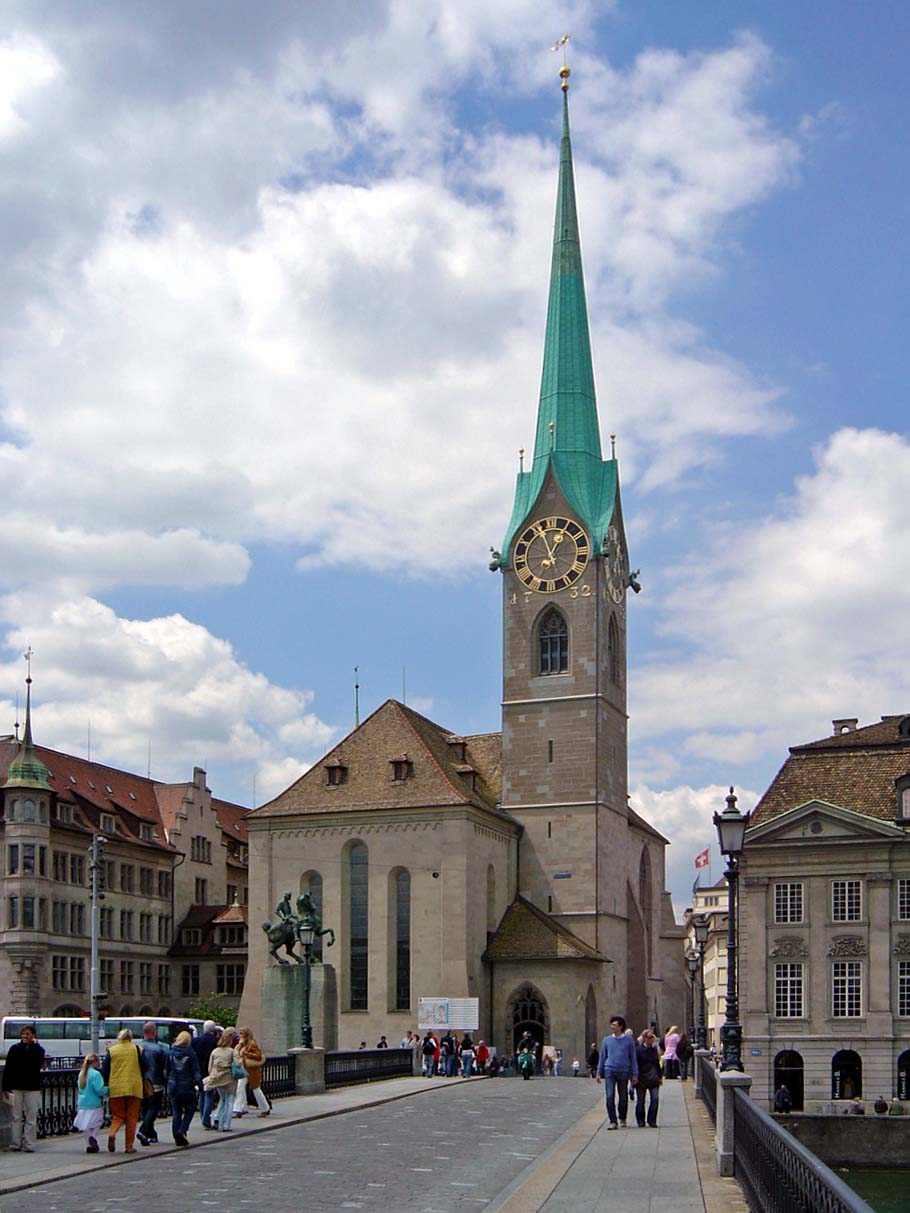
On the west side, the Fraumünster grew out of a convent for noblewomen that King Louis the German set up in 853 for his daughter Hildegard. The abbey was dissolved in 1524. What draws visitors now is the light: Marc Chagall's five windows in the choir, installed in 1970, each built around one dominant colour.
The clock and the hill
The climb ends at St. Peter. Its tower, raised to 64 metres in 1450, carries a clock face of more than eight metres across, one of the biggest in Europe. The mayor Rudolf Brun, the town's first independent one, was buried here in 1360.

Each church here shows a different chapter: a medieval foundation, a Reformation pulpit, an abbey turned into a gallery of glass, and a hilltop tower with a very large clock. Walk back down to the Limmat and you will have crossed all of it.