


Britain has been governed from this one strip of London for close to a thousand years. This walk follows it north from the river: a royal church, a Parliament, a prime minister's front door, the buried edge of a lost palace, and at the end a square built to celebrate a naval victory.
There are six stops, and the route is one straight line up Whitehall with a short detour to the river. Allow a half day if you go inside the Abbey and the gallery, and a good deal less if you only look from the pavement. Each stop says whether to go in, linger or pass by.
Palace of Westminster and Big Ben: the home of Parliament
Start by the river, at Westminster Bridge, and face the Palace of Westminster, with the clock tower at its north end. A fire in 1834 destroyed most of the old palace, and the buildings you see were designed by Charles Barry, with Augustus Pugin on the Gothic detail. Westminster Hall, from the Middle Ages, was one of the parts that survived.
The tower is called Elizabeth Tower, renamed in 2012 for the Queen's Diamond Jubilee. Big Ben is strictly the great bell inside, first rung in 1859, though almost everyone uses the name for the whole tower. A restoration that began in 2017 ended in 2022, so it is no longer hidden behind scaffolding.
Westminster Abbey: where monarchs are crowned
Across the square, Westminster Abbey has been the coronation church since 1066, and many kings and queens are buried inside. It is a working Anglican church, not a museum, which is why sightseeing stops on Sundays while services go on. Inside, head for the Poets' Corner, where writers are buried or remembered, and look up at the tall nave.
10 Downing Street: the prime minister's front door
Halfway up Whitehall, a side street closed by black iron gates leads to 10 Downing Street. George II offered the house to Robert Walpole, who accepted it, in the 1730s, as the office of the First Lord of the Treasury, which is still the prime minister's formal title. The gates went up in 1989, so the front door is something you see through the bars, not something you walk up to.
Whitehall Palace Steps: what is left of a royal palace
Whitehall is named after the Palace of Whitehall, the main London home of the monarch until a fire in 1698 destroyed most of it. Almost all of it has gone, though the Banqueting House survives. At the river end of Horse Guards Avenue you reach the former Whitehall Palace steps, part of a riverside terrace rebuilt by Christopher Wren in the early 1690s. They were uncovered in 1939 during building work for a government office, and the Tudor wall base beside them belongs to Henry VIII's palace.

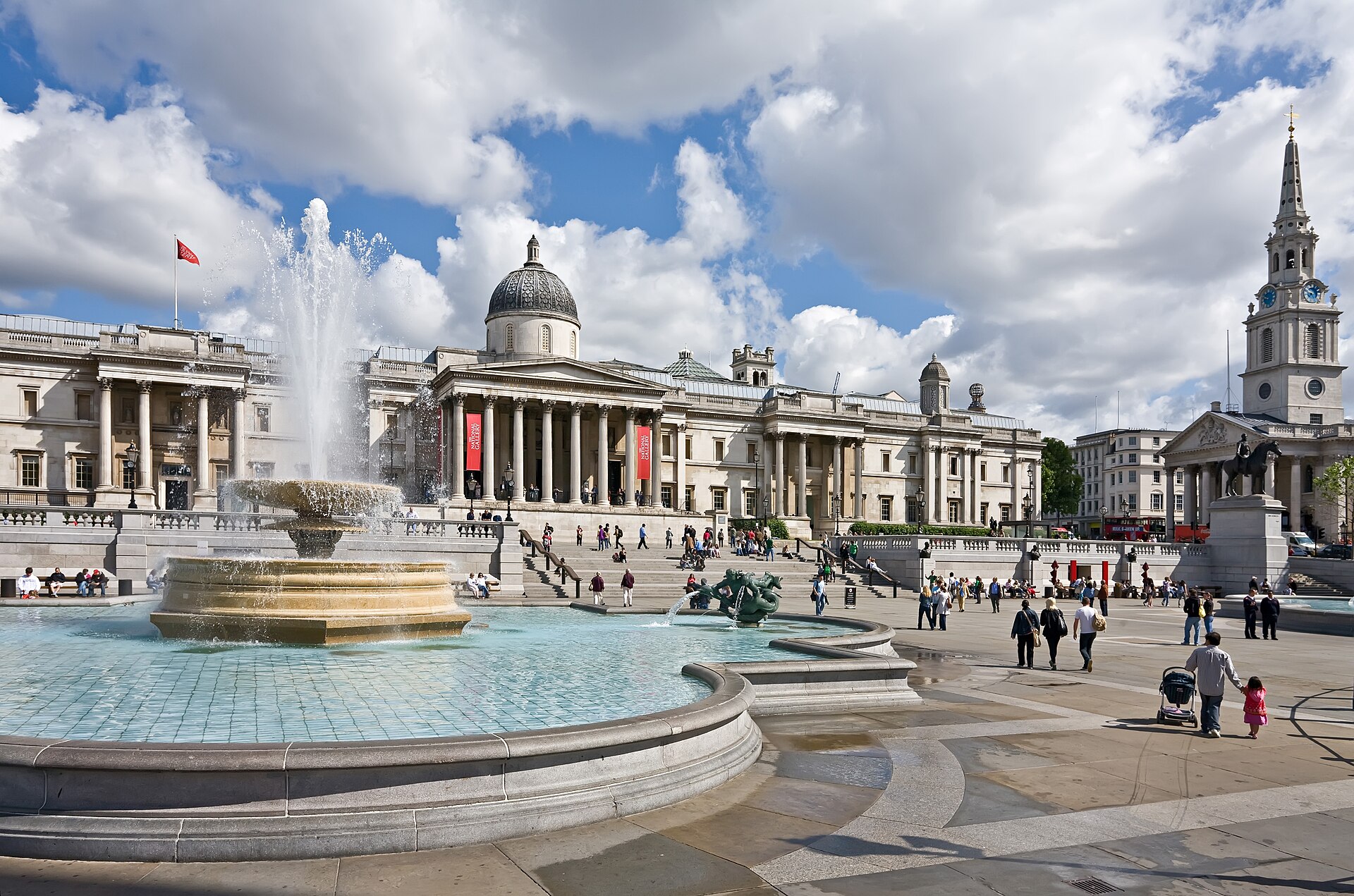
Trafalgar Square: a victory celebrated in the middle of London
Whitehall opens into Trafalgar Square, laid out in the early nineteenth century at Charing Cross. Nelson's Column commemorates the admiral who died at the Battle of Trafalgar in 1805. The northwest corner has a plinth that was left empty and is now used for a changing series of contemporary sculptures, so what stands there depends on when you come.
National Gallery: the end of the walk
The National Gallery fills the north side of the square and holds the national collection of European painting. General entry is free, and the gallery stays open until nine on Fridays. Some special exhibitions need a ticket.

In a straight line of a few hundred metres you have crossed from the old coronation church to the seat of Parliament, the house of the head of government, and the ruins of a palace that Parliament outlived. The square at the end is a reminder that government here has always shared the street with art and public celebration.